why are stripes so powerful?
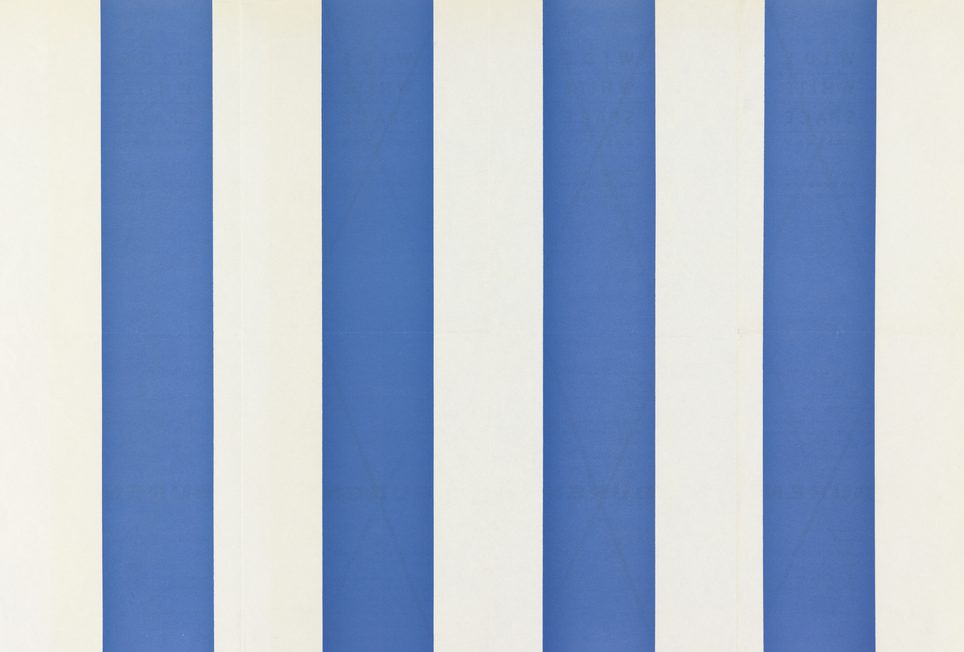
Parallel Lines, Infinite Thought: Why Stripes Matter
There’s something almost unsettling about a stripe the stripe may appear deceptively simple sometimes a repetition of parallel lines, orderly and predictable.
Two lines, perfectly parallel, never touching yet always in relation. It’s one of the simplest visual structures we know. And still, artists keep returning to it. Why?
__________________________________________________________________________________________________________________________________________________________________________
What does a stripe do?
A stripe divides space but it also creates the region of plane between two parallel lines. It imposes order, yet invites interpretation. When you look at repeated parallel lines, your eye begins to move, to measure, to compare. It invites us to think about how we see thinks and what we want to see.
The refusal of expression
Daniel Buren took this idea to an extreme. His work can be recognised from the well known strips of exactly 8.7 cm wide. Buren not only integrates this ‘visual tool’ into places where art is exhibited, but also into the streetscape, for example on buildings, in shop windows, on buses and advertising hoardings.
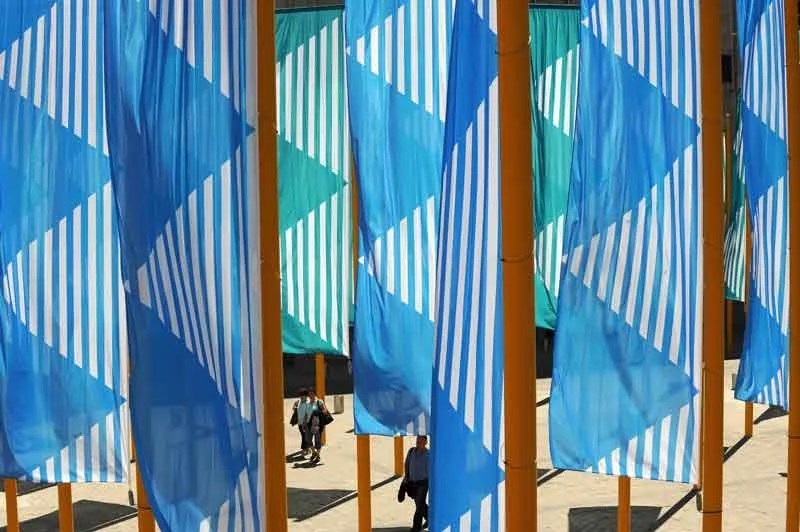
Daniel Buren – Blue on Yellow, 2009
When lines start to breathe
Now shift your gaze to Bridget Riley.
Her stripes don’t sit still. They pulse, bend, almost vibrate. The lines seem to move. not because they do, but because your perception can’t settle. Using “simple” vertical or horizontal, sometimes wavy, stripes, she creates intense, vibrating, and shifting visual sensations, turning static canvases into an experience that force viewers to engage actively with what they see.
 Cédric Tyberghien